

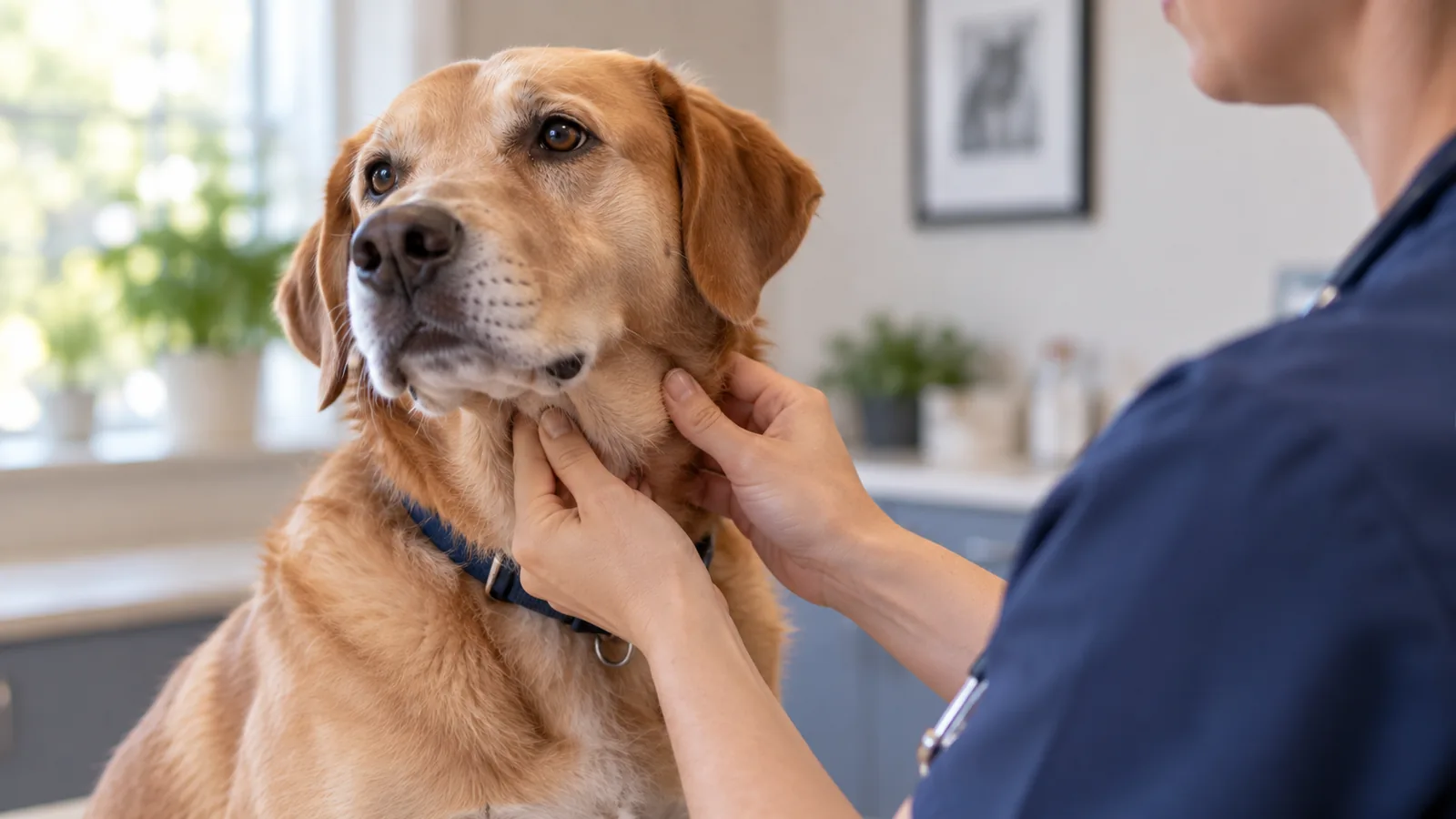
A swollen lymph node on your dog or cat is rarely an emergency, but it is not something to watch for a few weeks either; the right window is usually a day or two, and sometimes sooner. What you are feeling sets the pace: one tender node near a scratch, a sore tooth, or an ear infection usually means the immune system is handling a local problem, and an appointment within a couple of days is the right call. Several firm, painless nodes that enlarged quickly, especially if your pet is also tired, feverish, or off their food, belong at the front of the line and should be seen the same day. Waiting narrows the options rather than buying time: the pattern that would have pointed us toward an answer gets muddier, and if the cause turns out to be serious, the treatments that work best are the ones started early.
Alpine Animal Hospital provides veterinary care in Pocatello that starts with a hands-on exam, and a swollen node tells us a lot on the table before any test is run. We can sample the node with a small needle, run bloodwork, and use ultrasound when we need to look deeper. If several firm nodes appear on a Saturday night in a pet who is also feverish, listless, or refusing meals, that should not wait until Monday: we answer the phone after hours and keep room for urgent and same-day visits, whether the swelling sits on your dog, your cat, or under your horse's jaw. A single tender node in a pet who is still eating and acting normally can wait for our next open day, so request an appointment, describe what you felt, and we will decide together how soon they should be seen.
Four Things Worth Knowing Before We Look at That Lump
- Most swollen nodes are the immune system responding to something nearby, like a sore tooth, an itchy ear, or a scratch that got infected.
- Several firm, painless nodes that grew quickly are the pattern that concerns us most, especially in a dog or cat who otherwise seems fine.
- A needle sample of the node takes under a minute and settles a question another week of watching won't.
- A monthly hands-on check at home is how most families notice a change early, while the list of treatment choices is still long.
When Does a Swollen Lymph Node Need to Be Seen Right Away?
Several enlarged nodes in a pet who's also feverish, dragging, or off their food belong on today's schedule, and so does any swelling that crowds the throat or makes breathing noisy. One sore node in a bright, hungry dog or cat can wait a day or two. Slow growth over weeks still needs an appointment that week.
| What you're feeling | What it often means | How soon to be seen |
| One tender node near a wound, a sore tooth, or an infected ear | A local immune response to a nearby problem | Within a day or two |
| Several firm, painless nodes that grew fast | Systemic infection, immune disease, or lymphoma | Same day |
| Swollen nodes plus fever, hiding, or a skipped meal | Illness involving the whole body | Same day, after hours if needed |
| Swelling that changes breathing, swallowing, or voice | Pressure on the airway or throat | Right away |
| A node that's crept larger over several weeks | Chronic infection, immune disease, or a slower cancer | This week |
Two habits make the appointment harder before it starts. Squeezing or massaging a lump every hour irritates the tissue and teaches you nothing new. And never give leftover antibiotics from an old ear infection, because partial treatment can shrink a node just enough to blur what a needle sample would have shown us.
Our team handles urgent care alongside regular appointments. If you can't tell which row of that table you're in, give us a call and describe what you felt; two minutes on the phone usually settles it.
What Do Lymph Nodes Do When Nothing's Wrong?
Lymph nodes are checkpoints on the body's drainage network. Fluid from skin, muscle, and organs filters through them on its way back to the bloodstream, and the immune cells packed inside screen that fluid for bacteria, viruses, and cells that don't belong. When they're doing that job quietly, you shouldn't be able to find them.
Enlargement means the screening turned into a response: the node recruits cells, builds antibodies, and grows while it works. Swelling is the signal, not the disease itself. Five sets sit close enough to the surface to feel from the couch, and knowing the lymph node locations under the jaw, in front of the shoulders, in the armpits, in the groin, and behind each knee turns a vague worry into something specific you can describe on the phone.
We run our hands over all five sets at preventive care visits, which records a normal baseline for your pet before anyone needs it.
What Makes a Dog or Cat's Lymph Nodes Swell?
Infection, inflammation, immune disease, and cancer can all enlarge lymph nodes, and the pattern narrows things fast: one tender node points to trouble in the area it drains, while several firm, painless nodes across the body suggest something moving through the whole system.
Infections and Reactive Swelling
This is the largest category by far, and most of it ends well: a node beside an abscessed tooth or a foxtail wound is doing its job. We see the same logic in our large animal patients, where a swollen jaw node in a horse sends us looking at the throat first. Systemic infections behave differently and enlarge nodes in several places at once.
- Tick-borne: One tick bite is enough to pass along Ehrlichia and Anaplasma, which usually show up as fever, dragging energy, and nodes that puff up in several places at once rather than just one. Lyme disease belongs in that same conversation and often brings shifting lameness with it.
- Bacterial: Leptospirosis travels in standing water, irrigation runoff, and puddles that wildlife or livestock have urinated in, and it can swell lymph nodes while it quietly damages the kidneys and liver. Cats who hunt or spend time outdoors can pick up mycobacteriosis through bite wounds and scratches, which tends to leave firm, stubborn swelling in the node closest to the injury. Both can infect people too, one more reason to put a name on the problem instead of guessing.
- Fungal: Valley fever comes home with dogs who have traveled through the desert Southwest, sometimes enlarging nodes months after the trip. Blastomycosis and histoplasmosis live in damp river-valley soil farther east, and aspergillosis is possible nearly anywhere.
- Feline viruses: Feline leukemia virus and feline immunodeficiency virus both change how a cat's immune system behaves, and big nodes can be one of the earliest clues. A small blood sample answers that question.
- Parasites: Toxoplasma infection, a heavy load of intestinal worms, and skin crawling with fleas or mites all keep the immune system busy enough to enlarge nodes. A fecal test and a careful look at the coat rule those in or out early.
When the Cause Is Cancer
Canine lymphoma is the most common reason a dog's nodes balloon over a few days, and the hardest part for most families is that the dog is still eating, still playing, and still acting like himself. Roughly one in fifteen dogs born today will develop lymphoma at some point in life, and the odds climb closer to one in eight for lymphoma in Golden Retrievers. Newer blood-based screening tests can flag lymphoma months before a pet shows a single symptom, and the earlier that answer arrives, the more treatment options are still on the table.
This disease comes in subtypes, and the subtype drives everything after it, from which medications work to how long remission tends to last. Guessing costs the window when treatment does the most good.
Feline lymphoma usually starts in the intestinal tract rather than the nodes you can feel. Vomiting, loose stool, and slow weight loss are often the first clues instead of a lump under the jaw. Other tumors reach the nodes secondhand: mast cell tumors, melanoma, and carcinomas drain toward the nearest node first. That is the reason we sample that node along with the mass whenever we find one.
Immune-Mediated Causes, and a Few Others
Immune-mediated hemolytic anemia is the immune system destroying the body's own red blood cells, and the pale gums, sudden weakness, and reactive nodes that come with it look a lot like infection from the outside. Lupus and immune-mediated polyarthritis do something similar, arriving with fever, sore joints, and swollen glands.
Mild vaccination reactions can include a tender, slightly enlarged node near the injection site for a day or two, which is the immune system doing exactly what the vaccine asked it to do. Anything firmer, bigger, or still present a week later needs a look. None of these can be told apart by feel. The workup looks the same no matter which one we suspect.
How Do We Find Out What's Behind the Swelling?
Each step of the workup decides the next: the exam sorts the pattern and the urgency, a needle sample tells us which kind of cells are multiplying, and bloodwork and imaging fill in what's happening everywhere else. Most of it happens with your pet awake.
What the Exam Tells Us First
Palpation is more than noticing that a node is big. We're reading size against your pet's frame, texture, whether left and right match, whether pressure hurts, and whether the lump rolls freely under the skin or feels anchored to what lies beneath. A soft, sore, mobile node above a scratch on the same leg reads very differently from a hard, painless one that won't budge. The rest of the physical matters just as much, since the answer is frequently a rotten tooth, an ear full of infection, or a wound hiding between the toes.
Fine Needle Aspiration and Biopsy
Fine needle aspiration takes under a minute, uses a needle about the size of a vaccine needle, and most pets sit through it with a scratch behind the ears and no sedation at all. Those cells go onto a slide, and cytology answers the first question: reactive immune cells, an infectious organism, or a population of cancer cells crowding out everything else.
When cytology narrows the answer without settling it, a biopsy takes a piece of the node, or the whole node. The lab can then see how the cells are arranged in intact tissue and pin down a subtype. That's a short procedure under anesthesia, and your pet goes home the same day.
Bloodwork, Tick Panels, and Imaging
A complete blood count and chemistry panel show what glands can't: anemia, a white cell picture leaning toward infection, organ values that point at the kidneys or liver, and calcium that sometimes climbs with lymphoma. Testing for tick-borne and other infectious organisms runs alongside, because matching the medication to the right bug is the whole game in that category.
Chest radiographs and abdominal ultrasound assess the nodes nobody can feel, plus the spleen, liver, and lungs. When lymphoma is a possibility, that imaging is staging, and staging shapes both the plan and what we can honestly tell you about the road ahead. Our in-house bloodwork and imaging keeps most of this under one roof.
What Does Treatment Look Like Once We Know the Cause?
Treatment follows the diagnosis, never the reverse. An antibiotic given to a dog whose nodes are full of cancer cells buys nothing and costs weeks, and immune-suppressing drugs handed to a pet with a fungal infection make matters worse. Once it has a name, care tends to follow one of a few paths.
| What the workup found | What treatment usually involves |
| Local infection, abscess, or dental disease | Drainage or dental treatment, an antibiotic matched to the source, and pain control |
| Tick-borne disease | A targeted antibiotic course, often doxycycline, with most pets brightening within days |
| Fungal infection | Antifungal medication measured in months, with rechecks along the way |
| Immune-mediated disease | Medication that dials the immune response back down, plus close monitoring of blood values |
| Lymphoma | Chemotherapy aimed at remission, steroid therapy, or comfort-focused care, depending on the pet and the family |
Lymphoma deserves a straight answer: for most patients, remission is the goal rather than a cure. Remission can be good time, with dogs who feel well, keep their appetite, and hold onto their routines all the way through, and plenty of households choose a gentler road instead. Neither decision is the wrong one. We'll go through what each option asks of your pet and of you, and choose together.
Can You Lower the Odds of a Lymph Node Problem?
Lymphoma and the immune-mediated diseases can't be prevented, but a large share of the infectious triggers can. Vaccination, year-round parasite control, and a clean mouth remove several common causes, and regular exams catch the rest while the swelling is still small.
- Parasite prevention: Ticks stay active around southeast Idaho well past the first frost. Year-round products protect better than seasonal ones against both tick-borne disease and heavy flea loads. An annual fecal test covers the intestinal side.
- Vaccination: Core and lifestyle-based vaccinations cover leptospirosis and Lyme disease for dogs whose habits call for them, and feline leukemia for cats who spend time outside.
- Dental care: A mouth with active periodontal disease feeds bacteria into the jaw glands continuously, and professional dental cleanings under anesthesia are the only way to clear what sits below the gumline.
How Do You Check Your Pet's Lymph Nodes at Home?
Once a month, with your dog or cat relaxed, run flat fingers over the same five spots on both sides and pay attention to what's different from last time. You're not measuring anything, just noticing change: a node that feels larger or firmer than it did four weeks ago is the whole point of the exercise.
Start under the jaw, just behind the angle of the bone. Move to the front of each shoulder, then the armpit, then the crease of the groin, and finish behind each knee. Most pets read the routine as affection and lean into it.
If something has changed, or you're not certain what you're feeling, book an appointment. We’re happy to show you where the lymph nodes are and let you know if what you’re feeling is a problem.
Frequently Asked Questions About Swollen Lymph Nodes
Can a swollen lymph node go back to normal on its own?
A swollen node often does return to normal on its own. A gland that enlarged in response to an ear infection, a sore tooth, or a healing wound shrinks back once the trigger clears, sometimes inside a week or two. The catch is that you can't tell a shrinking node from a growing one by feel in the first few days, and the causes that don't resolve are exactly the ones where waiting costs the most. Anything still enlarged after about two weeks should be sampled.
Does a big node always mean cancer?
A big node usually does not mean cancer. Reactive swelling from infection or inflammation is far more common, particularly when a single gland is involved and it's tender to the touch. What raises our suspicion is a different picture: several nodes enlarged at once, firm rather than soft, painless, and growing over days in a pet who otherwise seems perfectly happy. A needle sample tells us which one we're looking at.
How do I tell a lymph node from an ordinary lump under the skin?
Location is the first clue. Nodes live in five predictable places. A mass anywhere else, such as the mid-back, a flank, or partway down a leg, is something else entirely: a fatty growth, a cyst, an abscess, or a skin tumor. Glands also come in pairs. Finding a matching one on the opposite side usually means you've found normal anatomy. Either way, anything new gets the same needle sample, and that's what separates them.
Let's Turn That Lump Into an Answer
A hands-on exam and a small needle sample turn a vague worry into a name, and a name turns into a plan you can act on. Earlier nearly always means more choices. Alpine Animal Hospital sees dogs and cats from all over Pocatello for exactly this. When you find something, book a visit and we'll take it from there.


Leave A Comment